
Century: Golem Edition - Eastern Mountains
- biggeeklittlegeek2
- Jun 30, 2023
- 5 min read
Being massive fans of the Original Century: Golem Edition we knew we had to add the other two games to our collection, so we have started off with Eastern Mountains. But how well does it hold up in comparison to it's predecessor?
One of the ideas I loved about the series was the playability of the games, how they could all be played as stand alone games, or you could mix and match them in any way you so wished, be that edition 1 & 2, 1 & 3, or all 3 games together etc.
For the purposes of this review, I will be talking solely about Eastern Mountains as a stand alone game.
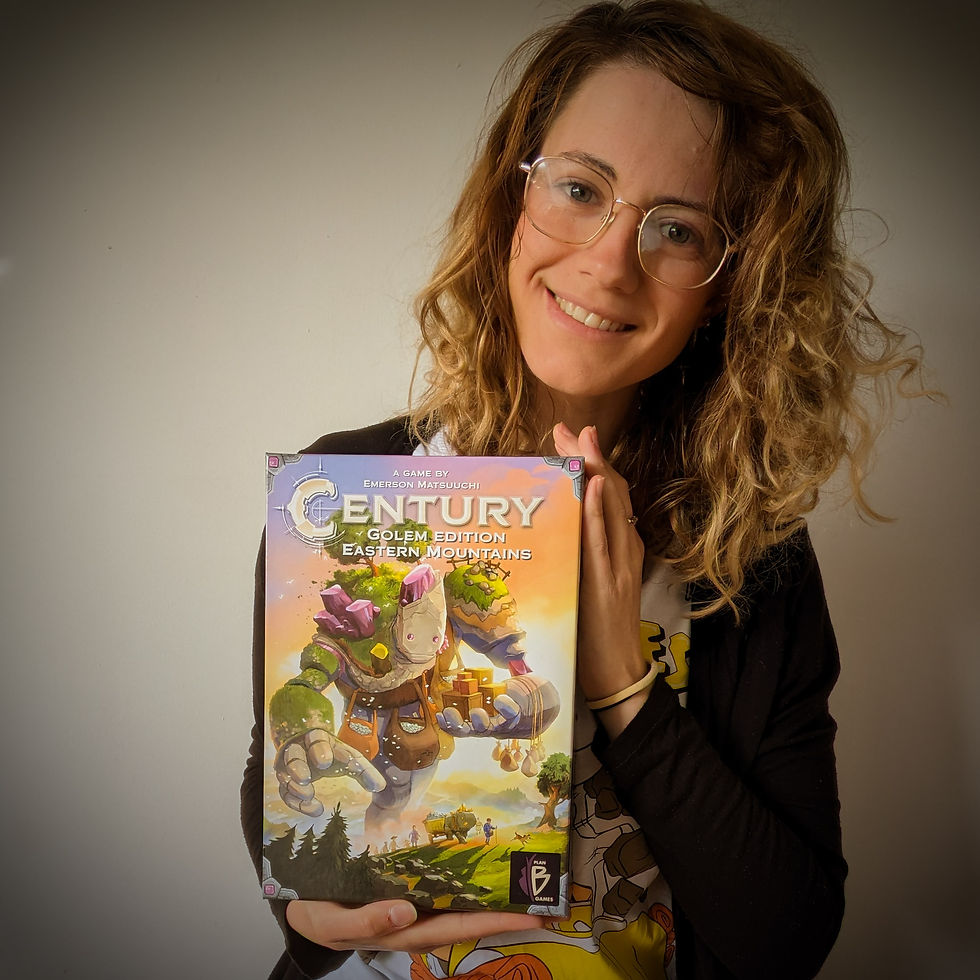
Publisher - Plan B Games
2-4 Players
30-45 Minutes
ages 10+ (recommended)
In Eastern Mountains Players return to their roles as caravan leaders, mining and trading crystal. But after having achieved success in your home village and along the Golem roads, you have ventured out into the vast Carvania mountain ranges in the hopes of establishing a trade network throughout the land.
Eastern Mountains is a game that requires point to point, grid movement across a modular board, while players are mining and trading crystals to achieve the village requirement and score VP.
The board is set up as described in the instructions, and each player then receives their own player board, wagon and outposts in their chosen colour. Each player receives the crystals from the 'starting crystals' option and places their wagon on any tile.
The game is played over a series of rounds which include players moving their wagon and performing one action. Movement is limited to one adjacent tile per turn (for free), or each extra mountain tile you move will cost one crystal from your board, which you must place on the tile as you leave it. So long as you have crystals to pay, you can move more than the one free space. If you end your turn on the same tile as another Wagon, you must pay them one crystal from your boards. After you have finished moving you may perform one of the following actions: Trade, Village, or Mine.
In order to Trade, you must first have an outpost on that tile. outpost cost varies on player count and number of outposts already built on that tile, you pay for them with crystals from your board. You then take the leftmost outpost from your board in the same coloured row that matches the Mountain tile, and place it on the tile. If you empty a vertical tile on you board while building an outpost you immediately choose a bonus tile for use in the remainder of the game. Now you have an outpost on a tile, you can perform the Trade action. Trading is simply exchanging the crystals depicted above the arrow for those below it. and you can trade as many times as you can, so long as you have the appropriate crystals to exchange.

Placed in the four corners of the board are the Village tiles, each containing VP and requirements to meet. If you have the correct crystals shown on the Village tile and move your wagon to the tile you can perform the Village action. return the appropriate crystals to the supply and claim the VP tile. Replace it with the red X tile and draw a new village tile to replace where the X originally was. The mine action is a simple stepping stone action to help boost you if you need it, it can be performed from any tile and you just take two yellow crystals from the supply.
The end of the game is triggered once a player has claimed their 4th VP tile, the round is finished as normal, then everyone counts up their VP total. you earn VPs from VP tiles, some bonus tiles, and for uncovered outpost spaces on your player board. Whoever has the most VP is the winner, whether they triggered game end or not.


So does this better to the original?
My answer would be yes for the most part. strategically there is a lot more to think about, which I love. It has taken all the elements of Century: Golem Edition that worked fantastically and levelled them up basically. With Eastern Mountains the modular board take the trading/upgrading crystals element to new strategic heights, instead of drafting cards to your hand, you are having to physically move your wagon across the mountain tiles to get to what you need. what makes it more strategic however, is the fact you can only move one tile for free at a time, meaning you have to truly think and manipulate your crystals in such a way to best benefit you to fulfil those village VP tiles. The fact it is a Modular board and random tile setup means every game is going to be different and strategy will change dependent on where the tiles are you best need in that particular game.
Unlike in Golem edition where you want to be trying to build up you hand before the card you want goes, everything in Eastern Mountains is accessible and visible by all players. Meaning you can see what your opponents have available to them, what VP tiles are available and you could try and work out their strategy as you play, which in turn would effect your own making it a much more head to head and interactive game.

The components to the game are all excellent, high quality. Thick and sturdy cardboard for the mountain tiles, the crystals are beautiful and colourful and the wagon and outposts are a good size and easy to handle. However, as beautiful and colourful as the artwork on the board is, the main thing that initially drew me to Century: Golem edition was the amazing, Fantasy, Manga style artwork, especially the Golems themselves, and they are non existent in Eastern Mountains. The theme is still evidently there and the art work is still exceptionally beautiful, it just doesn't hold up to that of the original game, and was a bit of a disappointment in that front. But, that will obviously be easily overlooked when playing the two together, and it is still a colourful and pretty game in its own right.
Overall, I can definitely say I am big fan of Eastern Mountain as well as Golem Edition, the strategy is spot on, it is engaging and beautiful. As a gamer who loves thematic and cosy games, this hits that sweet spot for me perfectly in the boardgame arena and I would definitely play a video game with the same theme and storyline. The modular board, makes for the perfect replayability, with endless possibilities for setups. If you enjoy Century: Golem edition I highly recommend adding this one to you collection too, or if you don't own the original, then why not try it anyway?
*Keep an eye out for reviews of both games played together, and for An Endless World.*


Comments